
How to Convert My PDF to Text
If you have ever stared at a PDF file wondering how to pull the words out of it without retyping everything by hand, you are not alone. Millions of people search every single day people searches for ways to “convert my PDF to text”, whether it is for a school assignment, a work report, or simply to edit content that got locked inside a static document. The good news is that turning a PDF into editable text is easier today than it has ever been, and in this article we will walk through everything you need to know about how to convert my PDF to text quickly, accurately, and without losing formatting.
Why People Need to Convert PDF to Text
PDF files are great for sending documents because they look exactly the same on every device and maintain a documents formatting perfectly. However, the same power is a disadvantage when it comes to editing the content. Unlike a Word document or a plain text file, you cannot easily copy or correct a paragraph or reuse a table from a standard PDF. Hence, numerous students, professionals, writers or researchers are seeking to locate a trustworthy PDF to Text conversion service every week.
Consider a student who scans a chapter of a textbook and saves it as a pdf and wants to reference a sentence in an essay. Or a customer who wants to order the numbers in a spreadsheet. Or a blogger that wants to convert an old PDF report to a new article. Each of these situations requires a reliable, rapid way to extract the text from my PDF so that the content can be reused. Try it Now:
What is the difference between text based and scanned pdf?
You will want to understand the type of pdf you are attempting to convert to text before you start doing so. Typically there are two types of PDF files.
The first type is a PDF that is filled in with text. This is a PDF created directly from a word processor (e.g. Microsoft Word or Google Docs) and exported as a PDF. Convertible text is typically already included under the visual layer in these files, making the conversion process relatively easy.
The second type is a scanned pdf or an image based pdf. This occurs when a printed document, such as a page of a book or a contract, is scanned and saved as a PDF. In this example, the file contains no real text data, it is only a picture. In order to convert my PDF to text from a scanned document, you will need a technology called Optical Character Recognition (OCR). This technology is used to detect the letters and words in the image.
If you know what type of file you have, it will save you time and make your decision easier if you are planning to convert your PDF to text.
How to Use Step-by-Step PDF to Text
Let’s explain the general procedure step-by-step and see what you do when you convert my PDF to text, whatever tool you use.
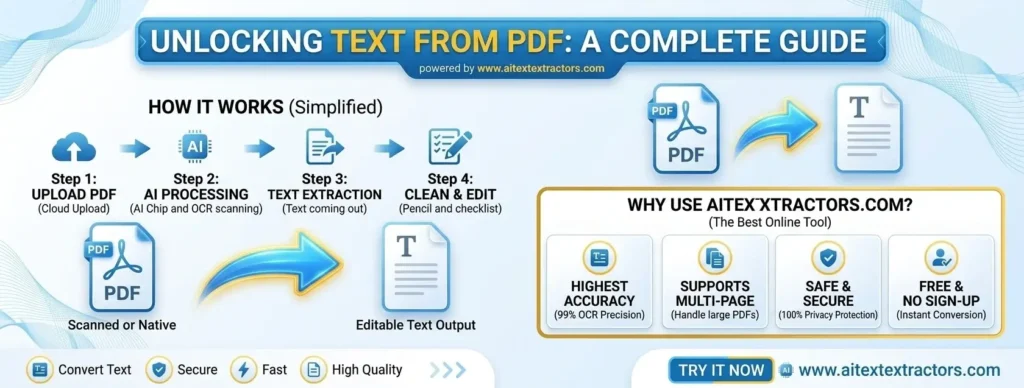
Step 1: See what type of PDF it is: Open the file and see if you can find a line of text with your cursor. Highlighting and copying the words is possible, then it is a text-based PDF. If there is no highlight and the page looks like a picture, then the PDF was scanned and will need to be OCRed in order to be able to extract the text from my PDF file correctly.
Step 2: Selecting a Conversion Method There are several methods to convert my PDF to text online, desktop applications, and OCR applications. Online tools are typically the quickest because they don’t require any software to be installed, and desktop software might be more private for sensitive documents.
Step 3: Upload the File: Most online PDF to text conversion tools will require you to upload or drag and drop your PDF file into a browser window. The upload speed will be dependent on the size of your file and your internet connection.
Step 4: Run the Conversion Click on convert button and wait for the software to work. If your document is a scanned PDF and requires OCR, this will take a bit longer since the scanner needs to scan and recognize each character on the page before it can accurately convert your my PDF to text.
It is a simple, but people hit a few wall with regards to switching my PDF into text.
Plain text files will not have bold or italics, columns or images. If you convert my pdf file to a txt file, you will not find much of my formatting as you will use a text file to keep the words intact, not the design.
OCR Errors: When a PDF file is scanned or printed at a low-resolution, the OCR engine might be misinterpreting some characters. When you convert my PDF to text from a blurry scan, sometimes numbers such as 0 and letters such as O can get mixed up.
Multiple-Column Layouts: There are multiple columns in academic papers and newspapers. Some tools have been unable to read them in the right order, and when you convert my PDF to text from such a layout, the output is scrambled up.
Language and Font Support: Not all converter supports all languages and handwriting style, so if you are taking care of an English document, check whether your selected tool supports your handwriting style and language prior to committing to it.
To get the best results, Here to the following tips:
When converting my PDF to text, these are some helpful tips to remember for best results.
First, remember to always begin with the best quality version of your PDF that you can get. A high resolution scan will always be more accurate when converting my pdf to text than a blurry photocopy.
Second, if you have a tool that only accepts a certain number of pages, break up large documents into smaller chunks. When converting pdf to text, I find it easier to upload a 20 page document or less at a time than a 30page document at once.
Third, double-check the results. Regardless of what the technology gets to be, if you convert my PDF to text, you will need to skim through the result before using it professionally because there may be some small errors.
Fourth, pay attention to your privacy. If your PDF has sensitive financial, medical, or legal data, choose your website for converting my PDF to text wisely as uploading sensitive files to unknown sites may be risky.
Last but not least, make a copy of the original PDF file. While conversions are generally safe, it is always a good idea to keep the source file in case you need to convert my PDF to text again using a different tool or settings later.
Who Benefits Most From Converting PDF to Text
Almost everyone eventually needs to convert my PDF to text at some point, but a few groups rely on it especially often.
Students and researchers frequently need to extract quotes, citations, and data from academic PDFs. Being able to convert my PDF to text lets them paste content directly into their notes or reference managers instead of manually retyping paragraphs.
Writers and content creators often repurpose older PDF reports, ebooks, or guides into blog posts or scripts. Converting saves enormous time compared to manual transcription.
Business professionals deal with scanned contracts, invoices, and forms daily. The ability to convert my PDF to text and then search or edit that content makes recordkeeping and data entry dramatically faster.
Developers and data analysts sometimes need to extract raw text from PDFs for use in automated systems, databases, or machine learning pipelines, where structured plain text is easier to work with than a locked PDF format.
People with visual or reading impairments may rely on screen readers, which work far better with plain text than with static PDF images, making the ability to convert my PDF to text an accessibility necessity rather than a convenience.
Free vs Paid Conversion Tools
When you search for a way to convert my PDF to text, you will notice both free and paid options. Free tools are usually sufficient for occasional, small-scale conversions and casual use. They typically have file size limits, may include watermarks, or restrict the number of conversions per day. AI Text Extractor is the best website with no sign up require and no limitations of daily usage, also give best Results.
Paid tools, on the other hand, often offer higher accuracy OCR engines, batch processing for multiple files at once, better security guarantees, and support for a wider range of languages and formats. If you need to convert my PDF to text regularly for professional work, instead of investing in a premium tool you can use aitextextractors it can save significant time and reduce errors in the long run.
Summary
Learning how to convert my PDF to text does not have to be complicated. Once you understand whether your file is text based or scanned, choose an appropriate tool, and follow a simple upload convert download process, you can transform almost any PDF into usable, editable text within minutes. Whether you are a student pulling quotes for a paper, a professional digitizing old records, or a content creator repurposing material, mastering the process to convert my PDF to text will save you countless hours of manual retyping.
The next time you find yourself stuck with a document you cannot edit, remember that you do not need advanced technical skills to solve the problem. With the right approach, you can convert my PDF to text in just a few clicks and get back to focusing on what actually matters: using that content productively.