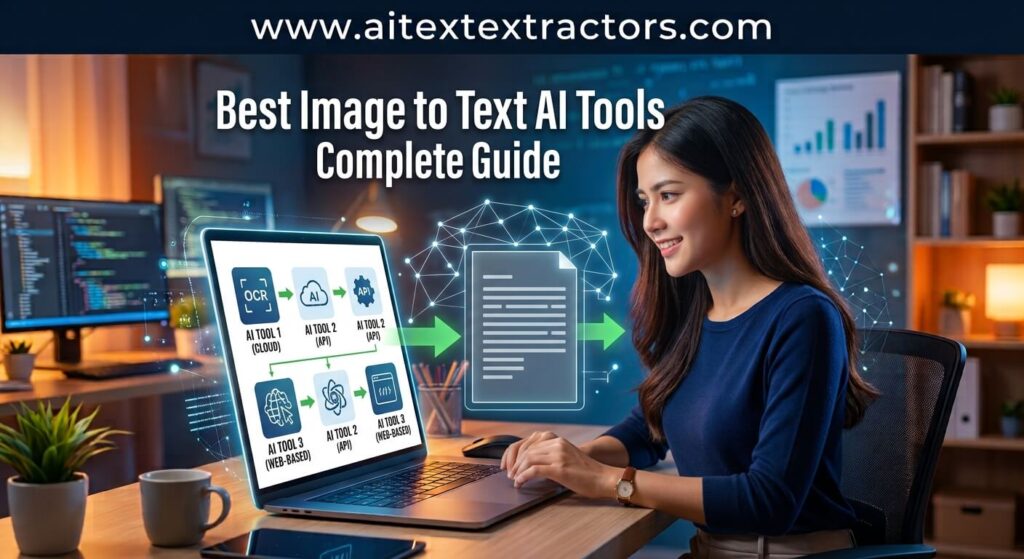
Best Image to Text AI Tool Complete Guide (Free & No Signup Required)
If you have ever tried to copy text from a photo, screenshot, or scanned document, you know the pain. Retyping paragraphs by hand is slow, boring, and full of typos. That is exactly the problem the best image to text AI tool solve and thanks to AI, it now takes seconds instead of minutes. Over the past few years image to text AI tools have gotten dramatically better. Older OCR (Optical Character Recognition) software used to struggle with blurry photos, low contrast screenshots, or messy formatting. Today AI powered tools handle all of that far more reliably, which is why so many students, freelancers, and small businesses now search for the best image to text AI option instead of typing everything manually.
In this guide, we are comparing some of the best image to text AI tools available right now what they do well, where they fall short, and which one might be the right fit depending on what you actually need to extract text from.
What Makes the Best Image to Text AI Tool?
Before we get into comparison it is useful to know what actually separates the best image to text AI tools from a mediocre one. Here is what we thought about:
Accuracy: Does it correctly read text from real-world images and not just perfect studio photos?
Free or paid: can you use it without hitting a paywall after a try or two?
No signup required: Do you really have to give up your email just to extract a paragraph of text?
Supported formats: Does it work with JPG, PNG and PDF or only one format?
Extra features: Does it clean up messy OCR output, or do you have to fix broken characters yourself?
It is easier to evaluate these five points which best image to text AI tool is actually worth your time.
Best Image to Text AI Tools Compared
We tested each candidate for the best image to text AI tool using the same types of files a phone screenshot, a scanned document, and a JPG photo of printed text and any social media post. Here is how they stack up.
1. AI Text Extractor (aitextextractors.com)
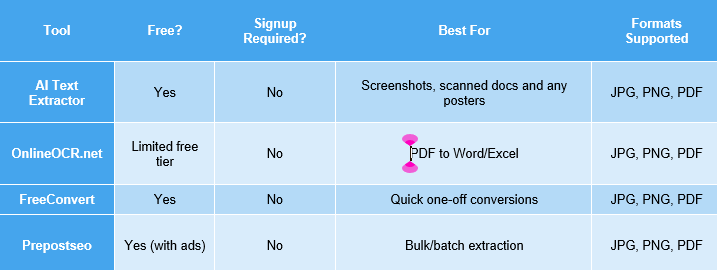
AI Text Extractor is a strong candidate for the best image to text AI tool if your focus is screenshots and scanned documents and social media posts, two of the most common real-world use cases people search for. It supports JPG, JPEG, PNG, and PDF files, and there is no signup or account creation required at any point.
Key features:
Handles screenshots (WhatsApp, Instagram, Twitter), scanned documents, PDFs and any social media post with strong accuracy.
Built-in “Clear Garbage Text” AI cleanup feature to fix broken characters and formatting after extraction.
Zero-log privacy policy, files are not stored on the server.
Pros: Completely free, no account needed, genuinely strong results on screenshots, scans, posters and PDFs, one-click cleanup for messy OCR output.
Cons: Currently supports English only, and processes one file at a time rather than in bulk. (Actually it is good for best Result)
Best for: Anyone looking for the best image to text AI tool for screenshots, scanned paperwork, copy text from any posters or single documents without a signup requirement.
2. OnlineOCR.net
This is onlineOCR another name you will frequently encounter in the best image to text AI roundups. It is a long-standing OCR tool that supports multiple languages and file formats, including PDF-to-Word conversion.
Features include:
Multi-language options
Batch conversion supported
Direct export to Word and Excel formats
Pros: Good for those who want output in editable Word/Excel files, not just plain text.
Cons: Old interface, and free-tier limits hit fast with batch files.
Best for: Those who want PDF to Word conversion specifically, not just text extraction.
3. FreeConvert Image to Text
FreeConvert Often listed among the best image to text AI alternatives, this tool is part of a larger file conversion suite and uses the open source Tesseract OCR engine.
Key features:
Simple drag and drop interface
Automatic file deletion after a few hours for privacy
No software installation required
Pros: Straightforward and easy for one-off conversions.
Cons: Fewer AI specific enhancements output can require manual cleanup on lower-quality images.
Best for: Quick, occasional conversions where formatting isn’t a priority.
4. Prepostseo Image to Text
Prepostseo is part of a broader SEO toolkit, as one of the best image to text AI options for batch extraction over several file types.
Main features:
Process multiple images at once in batch
SEO / Writing tools all-in-one
Pros: If you are already using Prepostseo’s other tools, this is useful too.
Cons: Free version has ads, and can lose accuracy on bad images.
Best for: Content creators who want to extract in bulk and don’t mind ads.
Quick Comparison Table: Best Image to Text AI Tools
How to Choose the Best Image to Text AI Tool for You
Not every best image to text AI tool is built for the same job, so “best” really depends on what you are trying to do:
Students and researchers extracting text from textbook screenshots or lecture slides will get the most value from a tool with strong screenshot accuracy and a quick cleanup step.
Businesses digitizing paperwork, invoices, receipts, old scanned records should prioritize tools that handle scanned documents well, not just clean digital photos.
Social media managers saving quotes or captions from Instagram, Twitter, or Pinterest screenshots need a tool that’s fast and doesn’t require an account for a quick one-off extraction.
Anyone processing large batches of files regularly may prefer a tool with bulk upload support, even if it means dealing with ads or tighter free-tier limits.
If your main use case is screenshots or scanned documents and you would rather not sign up for anything, the best image to text AI tool for you is usually a lightweight one built around exactly that, rather than a bulky all-in-one converter.
Tips for Getting the Most Accurate Results
Even the best image to text AI tool can only work with what you give it. A few small adjustments before uploading can make a noticeable difference in accuracy: You can improve the accuracy a bit by making a couple of small adjustments before uploading:
Light and contrast are good: The number one reason why OCR results come out messy: dark, shadowy or low contrast images. Let’s see if we can get this thing to run.
No blurry or low resolution photos: If you are taking a photo of a document, not scanning it, make sure that the camera is stable and the text is clear before you upload.
Remove extra background: Most tools work faster and more accurately if the image is focused only on the text area and not on large empty margins or unrelated visuals.
If possible, straighten tilted images: Text that is heavily skewed or rotated is more difficult for any OCR engine, including AI-based ones, to read correctly.
Use the cleanup feature if one is available: Tools like AI Text Extractor include a built-in cleanup step specifically because even accurate OCR engines occasionally misread a character or two. Running the output through a cleanup pass before copying it saves you from manually hunting for small errors.
Following even two or three of these tips can take an OCR result from “mostly usable” to “ready to paste” which matters a lot if you are processing several images in a row.
Frequently Asked Questions
Is AI-based OCR actually accurate?
Modern AI-powered OCR is significantly more accurate than older OCR software, especially on screenshots and scanned text. This is exactly why the best image to text AI tools tend to outperform basic converters, accuracy still depends on image quality, so clear, and high-contrast images consistently produce the best results.
Are free image to text tools safe to use?
Most reputable tools process your file temporarily and don’t store it afterward. Before uploading sensitive documents, it is worth checking whether a tool has a stated privacy or zero-log policy.
Can I extract text from an image without creating an account?
Yes several tools, including the ones listed above, let you upload and extract text with no signup at all. This is usually the fastest option if you just need a one-time conversion.
Which file format works best for OCR?
PNG and high-resolution JPG images with clear, high-contrast text tend to produce the most accurate results. Scanned PDFs also work well as long as the scan quality is decent.
Summary
Choosing the best image to text AI tool really comes down to matching the tool to your actual use case rather than picking whichever one shows up first in search results. If you are mostly dealing with screenshots or scanned documents or posters and want something free with no signup hassle, it is worth trying a tool like AI Text Extractor upload a file, extract the text, and clean it up in seconds.
Whichever tool you land on, the days of manually retyping text from images are pretty much over. Image to text conversion has gotten fast enough that it should never feel like a chore again.