
How AI Convert PDF to Text Tools Are Changing the Way We Work With Documents
Every day, millions of people around the world open a PDF file only to realize they cannot copy a single line of text from it. Maybe it is a scanned contract, an old research paper, or a report someone photographed with their phone. For years, the only solution was to retype everything by hand, a slow and frustrating process. Today, thanks to advances in artificial intelligence, the ability to use AI convert PDF to text tools has completely changed how individuals and businesses handle documents. What used to take hours now takes seconds, and the accuracy of these tools keeps improving every year.
Why people are increasingly turning to AI PDF to text Solutions?
The increasing need of AI PDF to text solutions is driven by several reasons.
The reason that was designed for PDF files is to make sure that the formatting will stay the same no matter what device or OS you are using. That is their biggest strength, however, also their biggest weakness. For one thing, a PDF is not editable content, it is actually a snapshot of a web page.
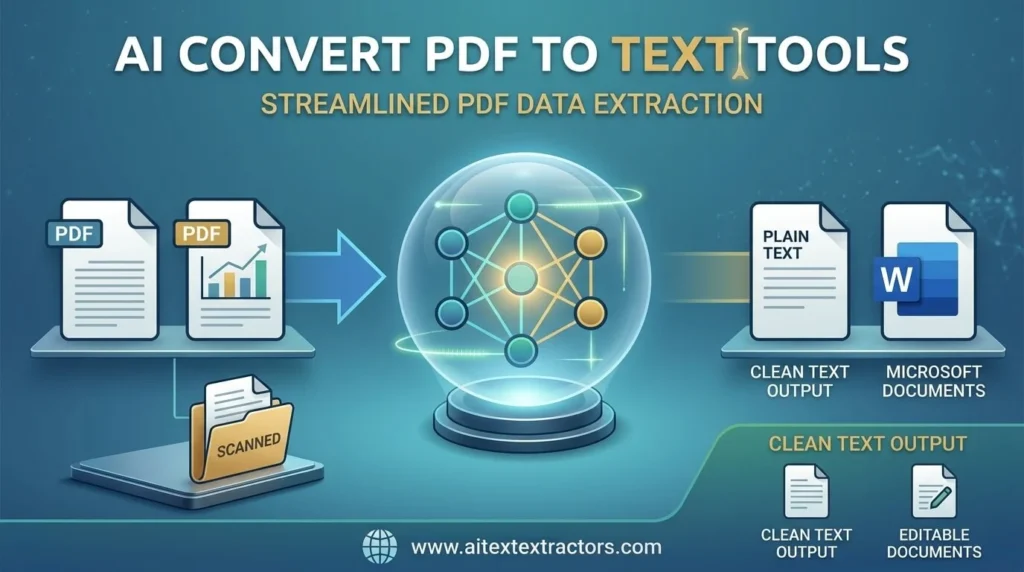
If you have to extract data from it, you will need special software or you will have to retype it. That is where AI convert PDF to text software comes in handy. But instead of it being a locked image, modern AI models are actually reading the page as a human would, identifying those letters, words and sentence structure, and then spitting out clean and editable text.
These AI Convert PDF to Text Tools are for taking notes from lecture slides as students learn. They are used by lawyers to extract clauses from the scanned contracts. To search through old archived reports, journalists use them. They can be used by businesses to electronically scan invoices and documents that would be left languishing in filing cabinets. The common theme in each of these is that the need is to convert a static, non-editable document to something searchable, editable and usable.
What is the process of converting PDF to text using AI technology?
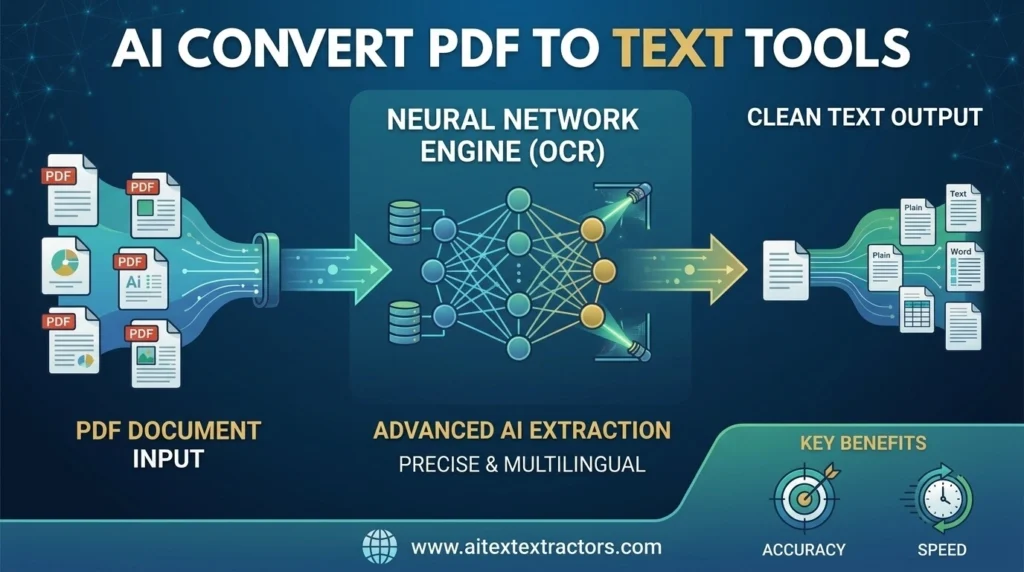
Most systems for AI Convert PDF to Text tools are based on a technology known as Optical Character Recognition, or OCR. While traditional OCR has been around for years, it would have difficulty with messy scans, unusual fonts, handwriting or documents with tables and columns. Today’s tools are unique because they are a mix of OCR and machine learning models trained on millions of documents.
These models are not only able to recognize shapes that look like letters, they also know what they are. When a portion of the page is slightly blurred, an AI convert PDF to text engine can often guess at what the smudged word is because of the context of the words around it and the way words are generally formed in language.
Advantages of AI Convert Pdf to Text Tool
This is a major leap forward. In the case of an imperfect document on which to scan, there would be a lot of random symbols and broken words in the text generated by the older scanning software. These mistakes are much fewer with newer AI-based tools as they learn to identify patterns like a human brain would recognise an imperfect handwriting or a bad photocopy. Hence, there are people who opt for an AI convert PDF to text tool rather than the conventional scanning software that printers would normally include.
The most apparent advantage of AI convert PDF to text is speed. A report scanned to 20 pages can be processed with in a minute, compared to an hour for retyping. This is particularly useful for companies that are involved in a great deal of paperwork, for example, accounting departments, law firms, and hospitals.
The AI convert PDF to textTool’s accuracy has significantly increased. Although no PDF to text system is perfect, today’s PDF to text programs can be highly accurate even when the input is a poor quality scan, faded or butter fingered ink, or an unusual font. It is even possible to use some tools for multiple languages in one document.
Another huge plus is search ability. PDF that has been converted to plain text can be searched. You can search for a specific clause or number, rather than scrolling through pages, which saves time.
Accessibility matters too. Screen readers can read PDFs aloud, enabling people with low vision or blindness to access them. Assistive technology can read converted text, but not PDF images that are locked.
The list is completed with edit ability. After transforming PDF to text with AI, users can copy the text into any text editor, format it once again, translate it, or reuse it in another project.
Uses of AI PDF to Text Converter
AI convert PDF to text tools are needed in almost all industries.
There are so many educational textbooks, handouts, and other resources that are only accessible in PDF. With AI powered PDF to Text conversion, they can highlight, annotate, and even copy parts to a study guide without having to retype anything.
In the legal domain, documents are often scanned and not legally drafted documents. AI PDF to Text tools are indispensable tools for lawyers, who use them to extract specific clauses and review them quickly, compare contract versions, or input the text into other legal research software applications.
Patient records that have been scanned years ago in healthcare are sometimes not in searchable text format. AI Convert PDF to Text tools enable hospitals to convert old records into searchable format, a valuable asset in cases of time sensitive tasks.
Typically, you will receive invoices, receipts, and tax documents as PDF or a scan in finance accounting. The semiautomatic approach for creating a text or structured data saves countless hours of accounting team worktime versus manual data entry.
In the publishing and journalism fields, researchers frequently have to deal with newspapers or other government reports that have been archived and are available only as PDF scans. These can be converted to text, which makes it easier to research and cite.
Features of Reliable AI Convert PDF to Text Tool
Here are some of the key features you should look for in a reliable AI Convert PDF to Text Tool, Not every tool is the same and if you are selecting a service to convert PDF to text with AI, you should take a few points into consideration.
First, verify the accuracy on your particular kind of paperwork. A tool could be great for typed PDFs, not so useful for handwritten PDFs or low resolution scans. It is always a good idea to test with a sample of your actual documents before signing up for a paid plan.
Secondly, think about language support. For those who work with multilingual documents, ensure that the AI PDF to Text tool you use is proficient with such languages, as the accuracy of each can differ.
Thirdly, consider formatting preservation. Some tools will simply spit out text in its raw format, while the more advanced will attempt to maintain paragraphs, tables and even simple formatting to make the output more manageable.
Lastly, think about what software the tool will integrate with, like word processors, cloud storage applications, or workflow automation systems. It should be seamless and not require additional tasks or procedures in order to convert PDF to text with AI.
A Simple Examples of AI convert PDF to text
Imagine a small business owner who just inherited a filing cabinet full of old supplier contracts, all stored as scanned pages with no digital copies anywhere. Searching through them manually to find payment terms or renewal dates would take days. By running the scans through a conversion tool, the owner ends up with plain, searchable text files within minutes. From there, key details like dates, prices, and clauses can be pulled out with a simple keyword search instead of flipping through hundreds of pages by hand.
This kind of scenario plays out constantly across offices, schools, and government departments that are still sitting on piles of paper records or old scanned archives nobody has had time to organise properly. Once the content is extracted, it can be sorted into spreadsheets, fed into other software, translated, or simply archived in a format that was not degrade or get lost the way physical paper eventually does.
It also means multiple people can access and search the same information at once, something that is impossible with a single physical folder or an unsearchable scanned image sitting on a shared drive.
Limitations of AI PDF to Text Converter
Even though AI convert PDF to text technology has come a long way, it is not perfect. Extremely poor-quality scans, unusual handwriting, or documents with heavy background noise can still trip up even the best systems. Complex layouts with overlapping text, watermarks, or dense tables can sometimes produce output that needs manual cleanup. It is always a good idea to review converted text for accuracy, particularly for important documents like legal contracts or financial statements, rather than assuming the output is one hundred percent correct.
Future of AI PDF to Text Converter
As AI models continue to improve, the gap between a scanned image and a perfectly formatted, editable document keeps shrinking. Future versions of AI convert PDF to text software are likely to get even better at understanding complex layouts, preserving formatting like bullet points and tables, and handling multiple languages within the same file. Some tools are already beginning to combine text extraction with summarization, meaning users was not just get raw text but also a quick summary of what the document says.
For now, though, the technology has already reached a point where it is genuinely useful for everyday tasks. Whether you are a student trying to extract notes, a business owner digitizing old records, or simply someone who needs to copy a paragraph out of a stubborn PDF, using an AI convert PDF to text tool is one of the simplest ways to save time and reduce frustration. What once required tedious manual retyping can now be done in moments, freeing people up to focus on the actual work that matters instead of fighting with file formats.
In short, the shift toward AI convert PDF to text solutions represents a small but meaningful piece of the broader trend of automation making every day digital tasks easier. As more people discover how convenient it is to convert PDF to text using AI, it is likely that these tools will become as standard a part of everyday computing as spell check or autocomplete already are.